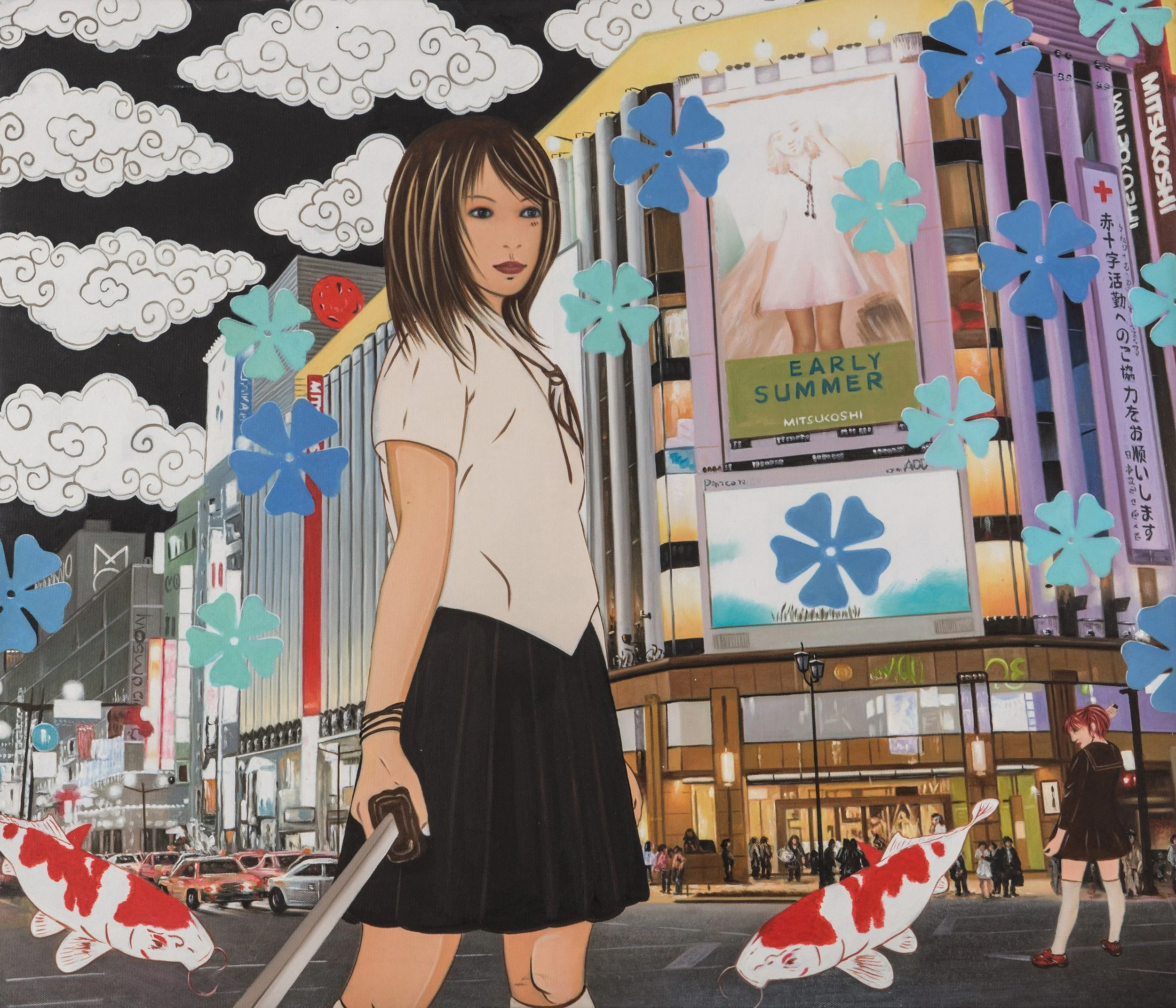

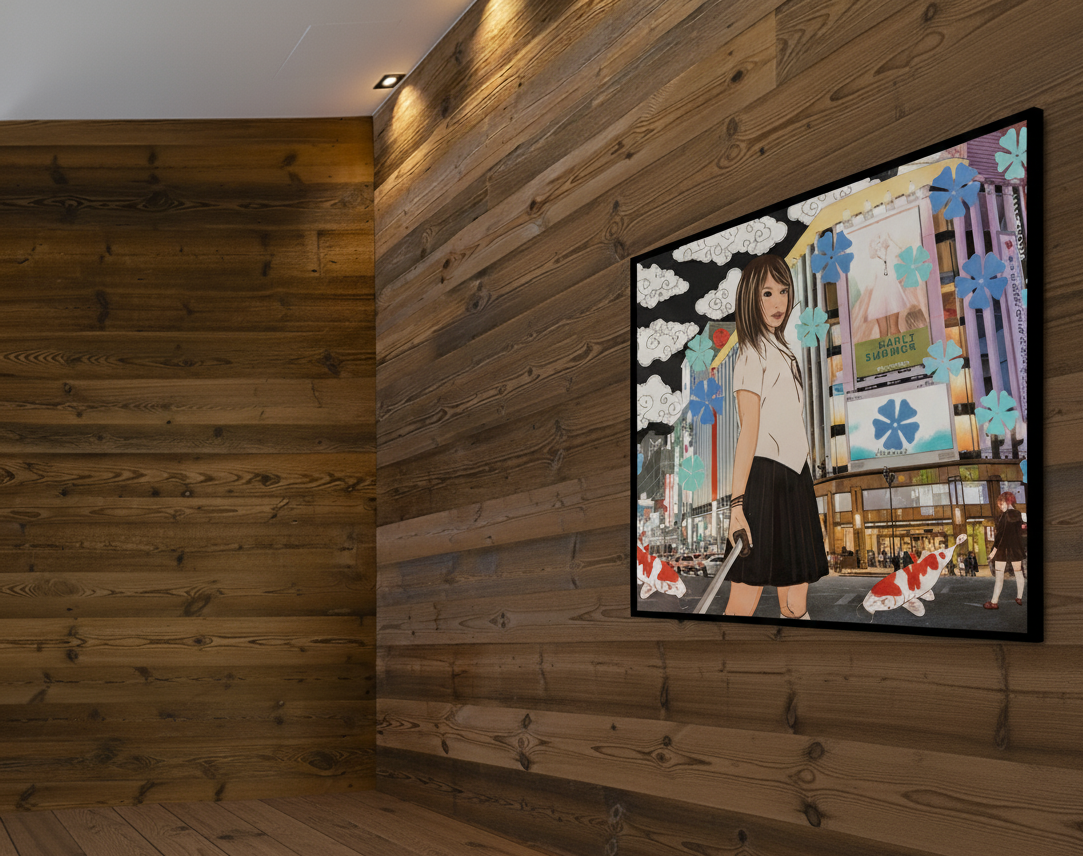

Early Summer Whispers in Battle Symphony: Tokyo Twilight Reverie unfolds within the series Tokyo Nocturnes: Blossoms and Clouds in Battle Symphony, where Hiro Ando investigates the fragile equilibrium between adolescent vulnerability and metropolitan intensity. Founder of the Japanese studio Crazynoodles and a leading figure of the Nippon Neo-Pop movement, Ando constructs here a twilight scene in which commercial luminosity intersects with a psychologically charged narrative. The schoolgirl, holding a sword with quiet determination, anchors the composition. She is not an isolated character but one of the four schoolgirls Hiro Ando has also rendered as polished metal sculptures in homage to the novel Battle Royale, creating a direct conceptual bridge between his painted and sculptural practices. This continuity across mediums reinforces the structural coherence of his artistic universe. The adolescent figure becomes a transversal motif, embodying resilience, tension, and emerging identity within the hyper-visual landscape of contemporary Tokyo. Around her, stylized flowers and graphic clouds—signature elements of Ando’s visual language—suspend temporality and introduce a dreamlike counterpoint to the density of illuminated façades and urban flow. Nishikigoi carp, traditional symbols of perseverance and transformation, glide through the scene as cultural emissaries linking ancestral heritage to electric modernity. The contrast between the school uniform and monumental architecture establishes a subtle dialectic between innocence and power, social conformity and self-assertion. Each element functions symbolically: the sword evokes survival, the blossoms suggest ephemerality, and the clouds open a contemplative, psychological space. This painting synthesizes Ando’s core themes—cultural hybridity, contemporary storytelling, and nocturnal poetics. For a collector, acquiring this work represents an exceptional opportunity to secure a pivotal piece within a cohesive body of work that interlaces painting and sculpture, affirming Hiro Ando’s central position in contemporary Japanese Neo-Pop.
Early Summer Whispers in Battle Symphony: Tokyo Twilight Reverie 2011
Materials Oil on stretched canvas
Size 23 3/5 × 30 7/10 × 1 1/5 in | 60 × 78 × 3 cm
Rarity Unique
Medium Painting
Condition Preserved in pristine StudioCrazynoodles condition
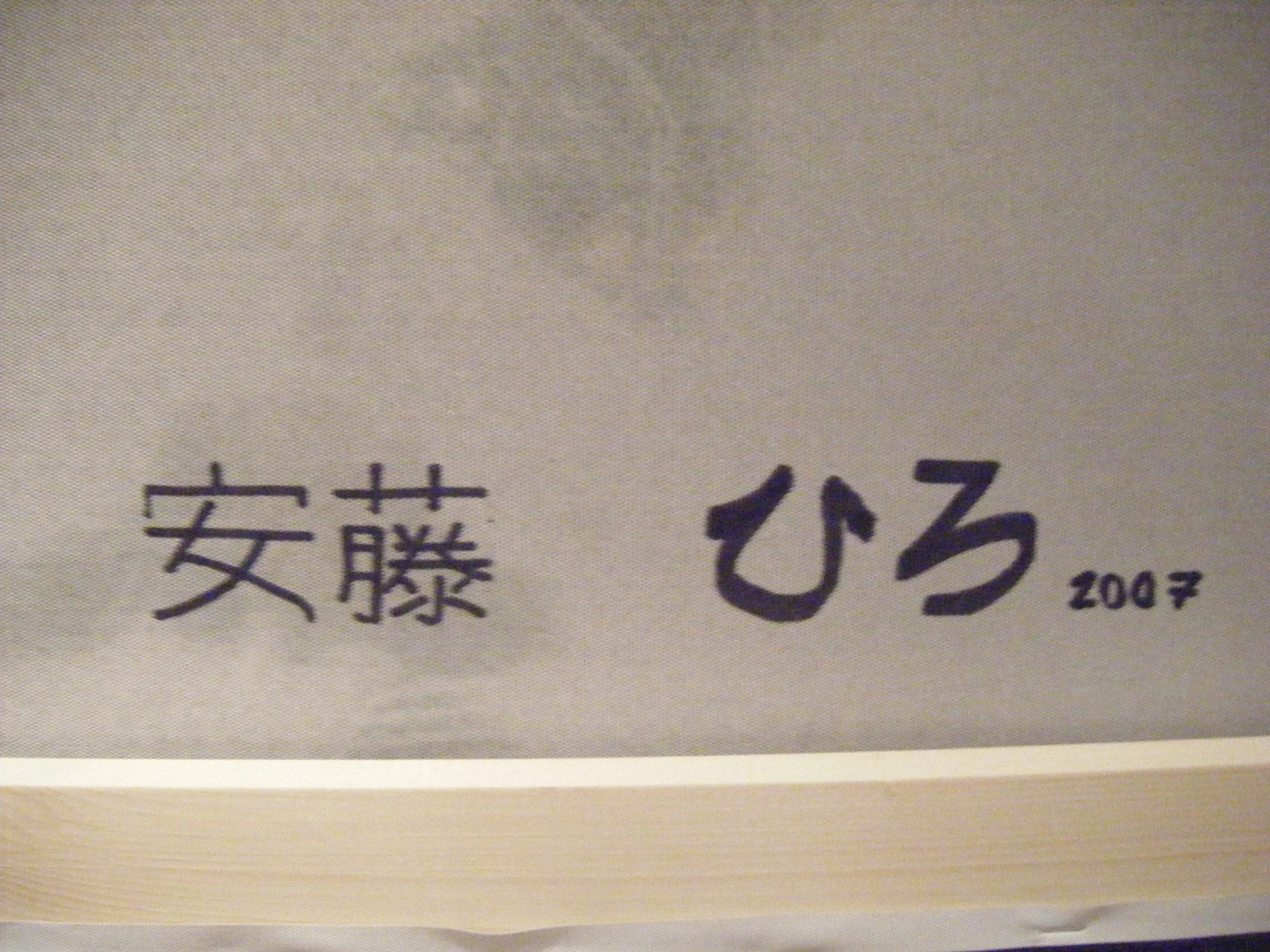
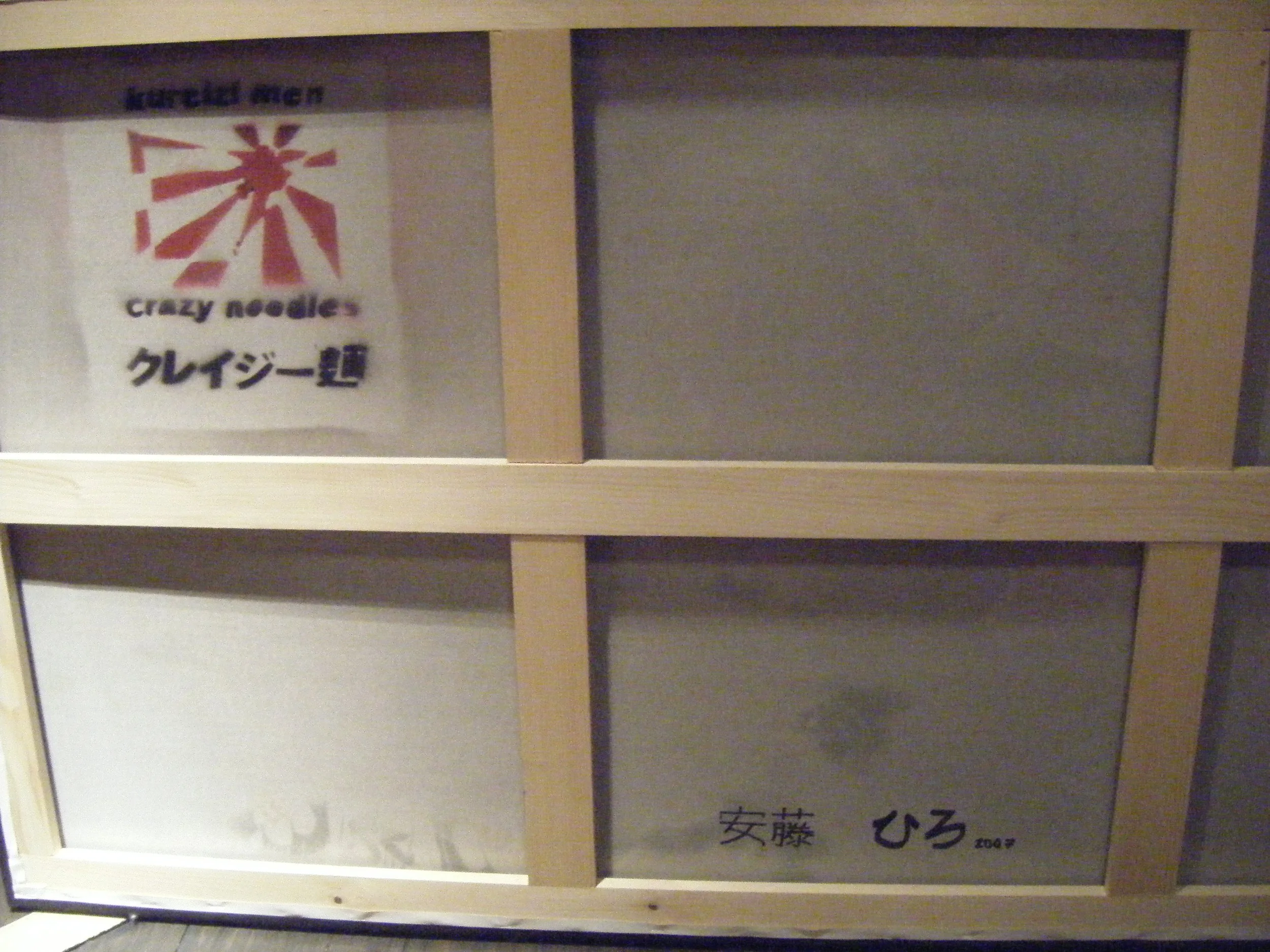
Signature Hand-signed by the artist - StudioCrazynoodles stencil emblem on the reverse - StudioCrazynoodles : Artistic label founded by Hiro Ando
Certificate of authenticity Included (issued by authorized authenticating body)
Frame Not included
Series Tokyo Nocturnes : Blossoms and Clouds in Battle Symphony
Image rights Visual rights managed by StudioCrazynoodles